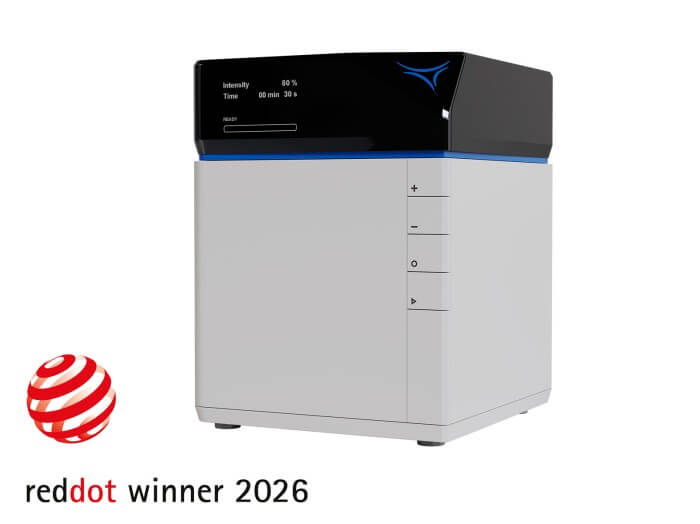
ibidi Micro Illumination System

Technical Features
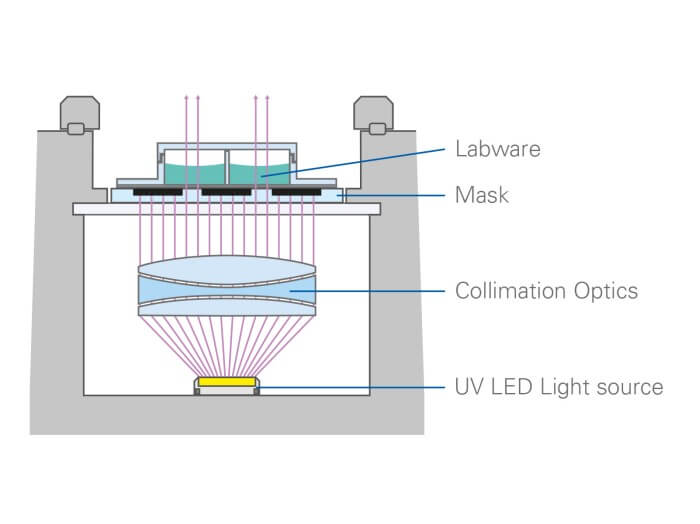
Inverted UV-Illumination
- Large homogeneous UV-illumination area for sharp pattern transfer due to the highly collimated 365 nm LED
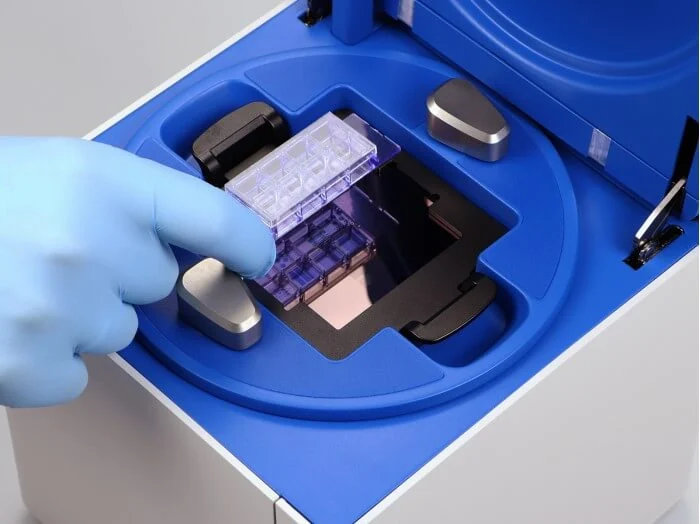
- UV exposure from below the sample, ideal for use with coverslip-bottom labware (e.g., µ-Slides and µ-Dishes)
Compact, Turnkey, and Flexible
- Small footprint benchtop system—no external equipment or infrastructure needed
- Intuitive user-friendly handling—no software installation or computer interface required
- Flexible usage—versatile microstructuring applications
Photomask Compatibility
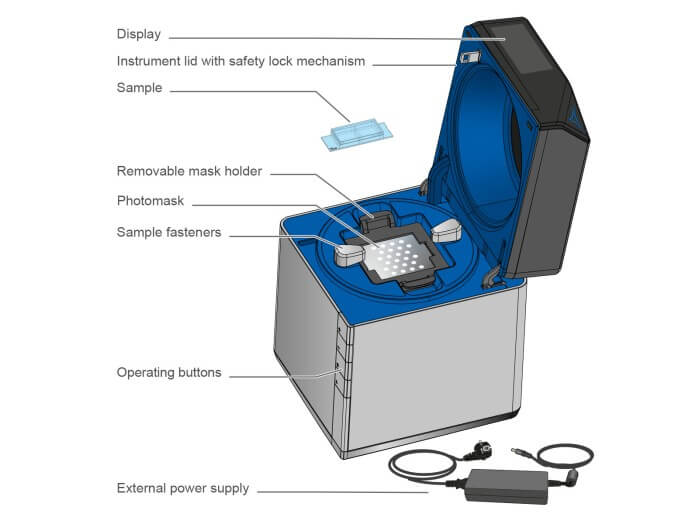
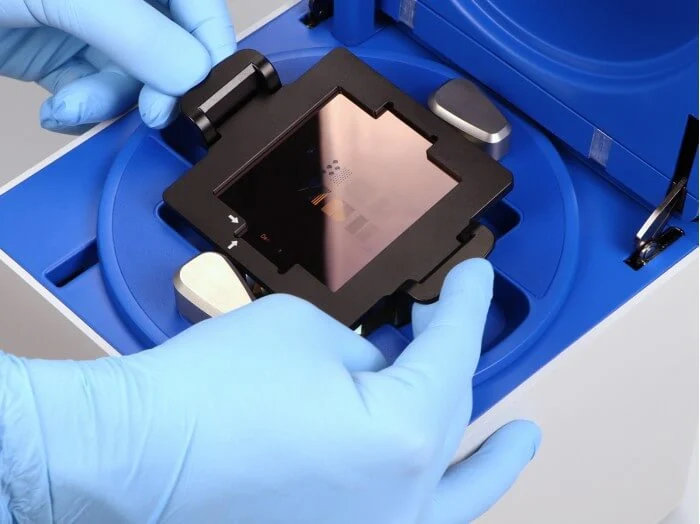
- Supports standard 3" photomasks for versatile patterning applications
Integrated Safety Lid
- Equipped with a secure lid and safety lock mechanism
Wet Lab Compatibility
- Designed for benchtop use in standard lab environments—no cleanroom required
Optional Accessories and Templates
- Optional Downholders: Minimize the gap between photomask and sample for optimal resolution and pattern transfer
- Optional Well Inserts: Reduce sample volume and meniscus effects in open-well µ-Slides to improve patterning consistency
- Ready-to-use mask templates for ibidi µ‑Slides and µ‑Dishes
Easy Start With a Demo Photomask
- The ibidi Micro Illumination System comes with a demo photomask for simple proof-of-concept experiments with your application
How Does the Micro Illumination System Work?
What is the ibidi Micro Illumination System?
The Micro Illumination System utilizes highly collimated UV light (365 nm) to initiate light-sensitive chemical reactions, enabling the precise structuring and patterning of materials at the microscale.
How Is the Technical Configuration of the System?
In an inverted configuration, UV light is projected from below through a photomask onto the sample, such as µ-Slides and µ-Dishes, for spatially controlled polymerisation, crosslinking, or surface functionalisation.
What Is the Principle of Light-Induced Chemistry?
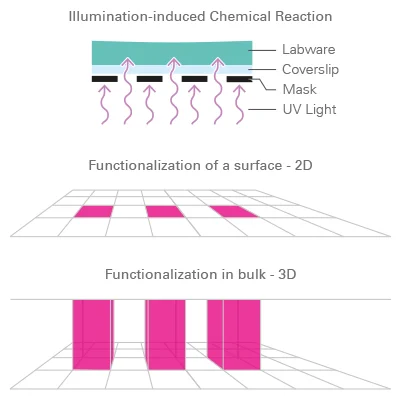
Ultraviolet light (365 nm) is utilised to initiate chemical reactions in various physical, chemical, and biological applications. A photomask is employed to shape these reactions by blocking light in specific areas, ensuring that exposure occurs only where it is needed. In surface-bound reactions, this process creates two-dimensional (2D) patterns. For reactions occurring in bulk materials, such as photo-crosslinkable hydrogels, three-dimensional (3D) structures can be formed.
What Is the Workflow for a UV-Induced Chemical Reaction?
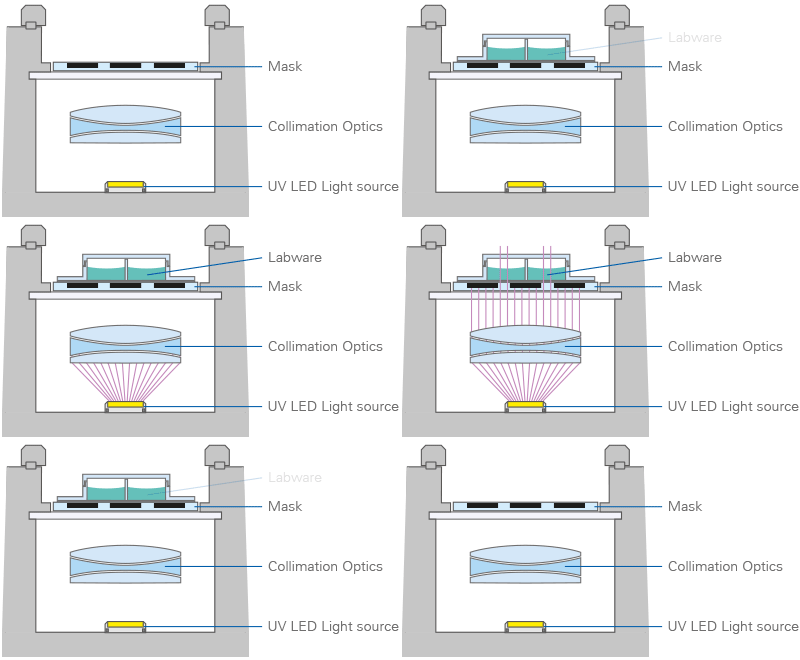
The ibidi Micro Illumination System simplifies the microfabrication process in just a few easy steps. First, prepare the labware, then insert the photomask and place the labware into the system to start the illumination process. Post-treat your sample if washing, coating, or other finishing is needed. Your custom microstructured surface is now ready to use.
What Is the Workflow for a UV-Induced Chemical Reaction?
The ibidi Micro Illumination System simplifies the microfabrication process in just a few easy steps. First, prepare the labware, then insert the photomask and place the labware into the system to start the illumination process. Post-treat your sample if washing, coating, or other finishing is needed. Your custom microstructured surface is now ready to use.

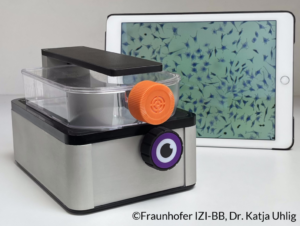
The ibidi Micro Illumination System is a compact, user-friendly benchtop platform that brings light-induced microfabrication into everyday laboratories without the need for a cleanroom. Compatible with coverslip chambers like µ‑Slides and µ‑Dishes, it supports a broad range of 2D and 3D methods, including photopatterning, hydrogel microstructuring, and photo-click chemistry. Users can precisely control where and when cells attach, migrate, and organize into tissues, enabling the generation of relevant microphysiological in vitro models.
Micropatterning
- Photopatterning: high-precision surface patterning guides cellular behavior. Spatially controlled surface functionalization or protein patterns define e.g., cell adhesion and migration
- Photo-induced wounding: light-induced generation of cell-free areas in confluent monolayers for wound healing and migration studies
- Spatial and temporal control of photo click chemistry
Microfluidics
- Fabrication of hydrogel-based microfluidics in ibidi Channel-Slides, enabling perfused microchannels, bifurcations, and flow restrictions
- Fabrication of fluidic systems that guide perfusion, mechanical cues, and chemical gradients—for lab-on-a-chip and organ-on-a-chip platforms (e.g., using the µ-Slide Tissue Engineering)
Microstructuring
- Photolithography and soft lithography with positive or negative photoresists
- Photopolymerization of photocrosslinkable hydrogels and bioinks (e.g., methacrylated gelatin (GelMA), collagen, hyaluronic acid, or PEG-DA, PEG-NB) to create defined 2D/3D microarchitectures
- Light-induced structuring of bulk materials or surfaces using 365 nm photoinitiators (e.g., Irgacure, LAP)
| Light Source | High-power UV LED |
| Wavelength | 365 nm |
| Intensity | 20 mW/cm² (@20%) – 100 mW/cm² (@100%) |
| Time | 1 s – 59 min, 59 s |
| Divergence | ≤ 3° |
| Illumination area | ⌀ 70 mm |
| Compatible photomasks | 3" masks, thickness 1.4–1.8 mm |
| Nominal resolution | 2 µm |
| Recommended feature size | >10 µm |
| Outer dimensions (l × w × h) | 200 mm × 215 mm × 260 mm |
| Weight | 6.6 kg / 14.6 lbs |
| Material | Multi-material construction |